When Kenyan businesses go through mergers, acquisitions, or investment rounds, lawyers conduct extensive due diligence on intellectual property, contracts, and corporate structure. They value physical assets, review financial statements, and examine legal liabilities.
But here’s what often gets overlooked: the digital assets that increasingly represent significant business value.

Your website, your domain name, your social media presence, your email list, your online reputation—these aren’t just marketing tools. They’re business assets that can be valued, protected, transferred, and lost. And unlike physical assets or traditional intellectual property, most entrepreneurs don’t think about protecting them until something goes wrong.
Smart business owners in Nairobi, Mombasa, and across Kenya are starting to understand something that corporate lawyers have known for years: your online presence isn’t separate from your business. It is your business, at least the part that most people see.
Let me show you why this matters and what you need to do about it.
When Your Digital Presence Has Monetary Value
Think about established Kenyan brands. Their value isn’t just in their inventory, their offices, or their equipment. A significant portion of their value exists in their brand recognition, their customer relationships, and their market position—most of which manifests digitally.
A domain name can be worth more than office furniture. If you’ve built a recognizable brand around a specific domain (like Bitala & Kakinga building their reputation around bitalakakinga.com), that domain has real value. It represents years of marketing investment, customer recognition, and SEO authority.
Lose access to that domain—through security negligence, registration lapses, or disputes—and you lose something worth potentially hundreds of thousands or millions of shillings. You’re not just losing a website address; you’re losing the digital doorway that customers use to find you.
Your email list and customer database are valuable assets. If you’ve spent years building relationships with clients, collecting leads, and nurturing prospects through email marketing, that database has quantifiable value. It represents future revenue potential and business goodwill.
If that database gets compromised through a security breach, or lost because you didn’t have proper backups, you’re not just experiencing an operational problem. You’re experiencing a loss of business value that would show up on a balance sheet if you were selling the company.
Your online reputation is an asset that compounds over time. Good reviews, testimonials, case studies, media mentions—these build business value. They make customer acquisition easier and cheaper. They increase pricing power. They attract better partnerships and investment opportunities.
Conversely, reputational damage from security breaches, website failures, or unprofessional presentation destroys value that took years to build.
The Security Liability That Entrepreneurs Ignore
Most Kenyan business owners understand physical security. They install gates, hire guards, and lock their offices at night. They insure against theft and property damage.
But digital security? That gets treated as an afterthought until something goes catastrophically wrong.
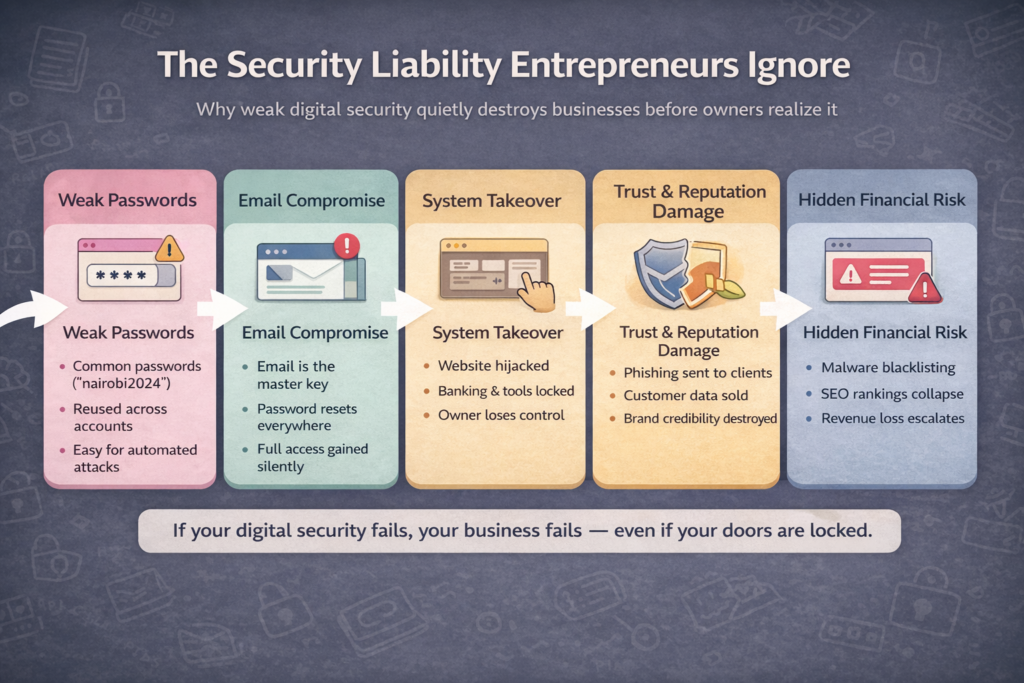
Here’s what actually happens in a typical breach:
Your business uses “nairobi2024” as the password for your company email. It’s easy to remember and you’ve used variations of it across multiple accounts. An automated script tries common passwords on your email provider. It gets in.
Now the attacker has access to your email, which means they can reset passwords for everything else—your website, your banking, your social media, your client management systems. Within hours, they’ve locked you out of your own business’s digital infrastructure.
They might sell your customer list on the dark web. They might send phishing emails to your clients pretending to be you, destroying trust relationships that took years to build. They might alter your website to distribute malware, which tanks your search rankings and gets you blacklisted by browsers.
The financial cost is measurable. The reputational cost might be terminal.
The Professional Credibility Premium
Let’s talk about something that’s difficult to quantify but extremely valuable: professional credibility.
When you’re competing for a major contract, or pitching to investors, or trying to win a client away from an established competitor, the decision often comes down to subtle factors. Who seems more credible? Who appears more reliable? Who looks like they have their act together?
Your digital presence is where these impressions form.
Two businesses offer similar services at similar prices. One has a fast-loading website with professional design, clear information, and cohesive branding. The other has a slow website with clashing fonts, inconsistent layouts, and amateur visuals.
Everything else being equal, who gets the business? The answer is obvious, even if the decision-maker can’t articulate exactly why they feel more confident about the professional-looking option..
For a business where perception determines opportunity, this level of polish isn’t vanity—it’s competitive advantage.
Website performance is a credibility signal. A website that takes ten seconds to load, or that crashes when accessed from mobile phones, or that displays error messages—this communicates incompetence before anyone reads your content. Potential clients, investors, and partners make judgments based on these details. “If they can’t keep their website running reliably, can they reliably deliver on their promises?”
Due Diligence Includes Digital Assets
If you ever plan to raise investment, seek acquisition, or sell your business, understand that sophisticated buyers conduct digital due diligence just as thoroughly as they review legal documents.
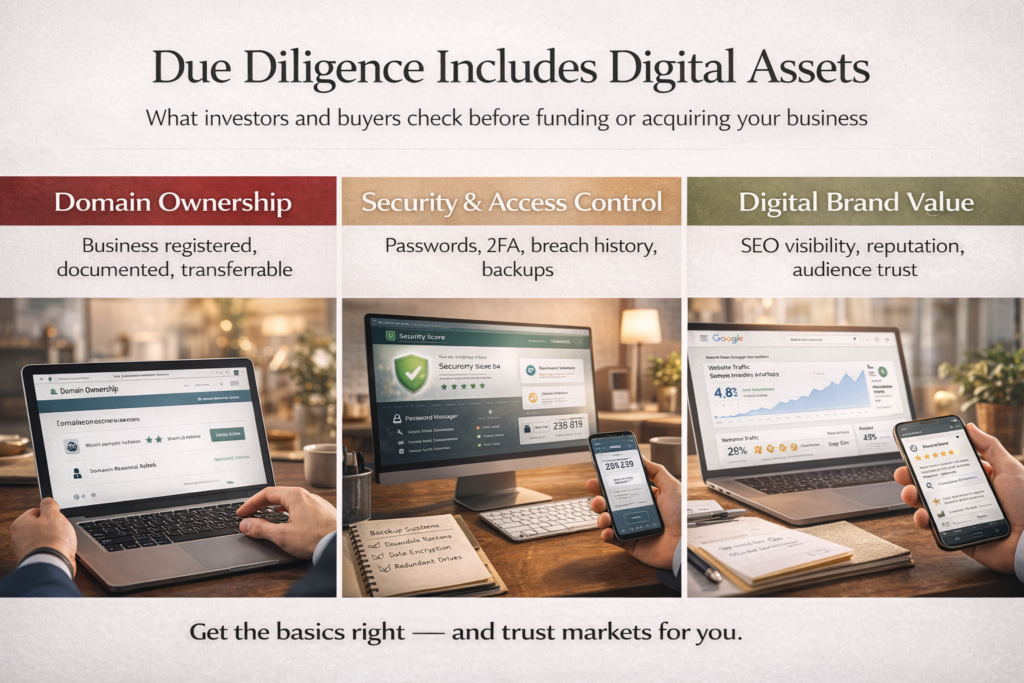
They’ll evaluate your digital asset security. Do you own your domain names outright? Are they registered under the business or under someone’s personal account? What happens if that person leaves the company? Do you have proper documentation of ownership?
Can you demonstrate secure access controls? Have you ever experienced security breaches? How do you manage passwords and sensitive credentials? What backup systems protect against data loss?
These aren’t hypothetical questions. They’re standard due diligence checklist items that determine valuation and deal structure.
They’ll assess your digital brand value. What’s your search engine visibility? What’s your domain authority? How much organic traffic do you receive? What’s your online reputation look like across review sites and social media?
All of this represents value—or liabilities—that affect what a buyer will pay and what terms they’ll accept.
They’ll review your technical debt. Is your website built on current technology or outdated platforms? Is your code properly documented and maintained? Can systems be transferred cleanly to new ownership? Are there hidden technical problems that will require significant investment to fix?
Companies built on proper digital foundations command better valuations than companies with amateur or neglected digital infrastructure.
The Kenya-Specific Digital Context
Operating in Kenya creates specific considerations for how you approach your digital assets.
Mobile dominance affects everything. With M-Pesa’s success and widespread mobile internet adoption, your digital presence must be mobile-first. Not mobile-friendly as an afterthought—mobile-first as a primary design principle.
This means your website loads quickly on slower connections. It works perfectly on smaller screens. It’s designed for touch navigation, not just mouse clicks. It doesn’t consume excessive mobile data.
A beautiful desktop website that’s unusable on phones is a business liability in Kenya’s market.
Infrastructure challenges require better preparation. Power outages, internet disruptions, and connectivity issues are part of Kenya’s business reality. Your digital infrastructure needs to account for these challenges.
This means choosing hosting that has proper uptime guarantees and redundancy. It means having backup systems for critical data. It means communication channels that work even when primary systems are compromised.
Businesses that treat infrastructure reliability as optional lose opportunities when systems fail during critical moments.
Regional reputation matters disproportionately. Kenya’s business community is interconnected, especially within specific industries or regions. Your digital reputation—reviews, testimonials, social media presence—travels quickly through these networks.
A security breach that exposes client data, or a website failure during a high-profile launch, or unprofessional digital presentation that becomes a talking point—these incidents compound through word-of-mouth in ways that are difficult to recover from.
Protecting your digital reputation isn’t just protecting marketing efforts. It’s protecting social capital within business communities where relationships drive opportunities.
Building Transferable Value
Whether you plan to eventually sell your business, pass it to family members, or scale it through investment, building transferable digital value matters.
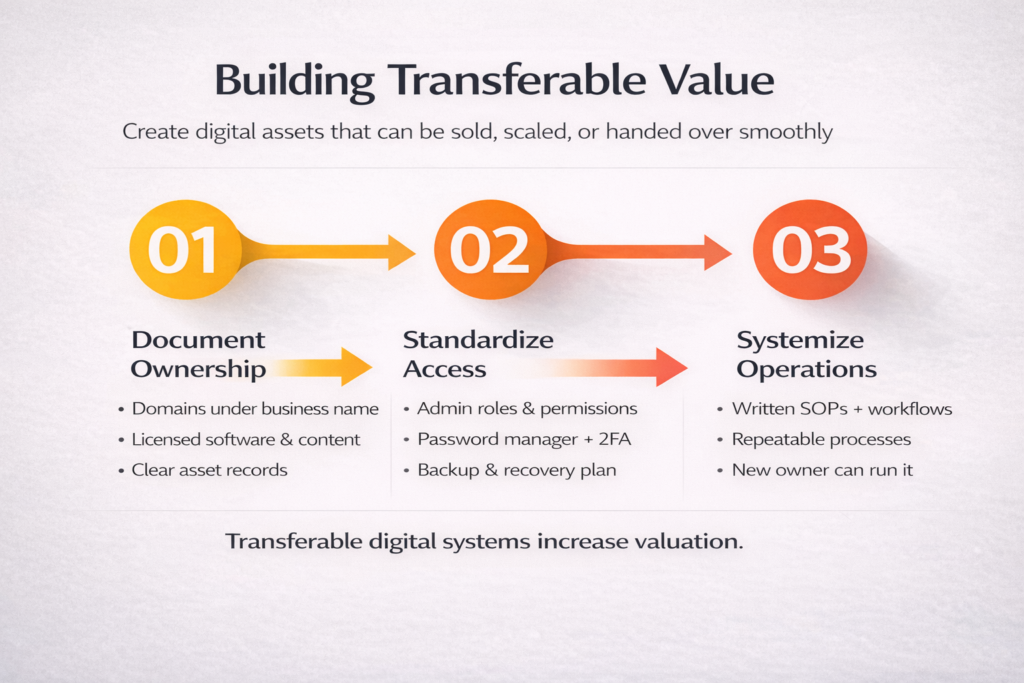
Documentation and ownership clarity are essential. Every digital asset should have clear ownership documentation. Domain registrations under the business name. Properly licensed software and content. Clear records of who has access to what systems and under what authority.
This seems obvious, but it’s commonly neglected. Businesses discover during acquisition negotiations that their founder personally owns the domain name, or that critical systems are tied to an employee’s personal account, or that they don’t actually have licenses for software they depend on.
These issues tank deals or reduce valuations when they’re discovered.
Standardized systems and processes create value. A business that runs on founder knowledge and informal processes is difficult to transfer. A business with documented systems, standardized procedures, and professional infrastructure can be operated by new ownership.
Your digital systems should reflect this same professionalization. Not just “it works,” but “it works in a way that can be handed to someone else with proper documentation.”
Security practices protect transferable value. A business with a history of security breaches, or with poorly managed access controls, or with unknown vulnerabilities in its systems—this represents risk that reduces value.
Conversely, a business that can demonstrate mature security practices, regular backups, proper access management, and no history of significant breaches presents as a lower-risk acquisition..
Taking Action Before Problems Force Your Hand
The best time to establish proper digital asset management is before you need it—before you’re negotiating an acquisition and discover your domain registration is a mess, before a security breach exposes client data, before amateur presentation costs you a major opportunity.
Audit your current digital assets. What do you own? Who has access? How is it protected? What would happen if key people left or systems failed? Where are the vulnerabilities?
Implement security best practices now. Unique random passwords for every account. Password managers to maintain them. Two-factor authentication where available. Regular backups with tested restoration procedures. Clear access controls that can be revoked when needed.
Invest in professional presentation. Your website should reflect the same level of quality as your legal documents. Fast loading, mobile-optimized, professionally designed, with typography and branding that communicate competence and credibility.
Document everything. Who owns what. Who has access to what. What licenses cover which assets. Where backups are stored. How systems can be transferred.
Work with professionals who understand this integration. Just as you wouldn’t let an amateur handle your corporate structure, don’t let amateurs handle your digital infrastructure. Get proper hosting. Get professional design. Get security expertise where needed.
The investment in doing this properly is far smaller than the cost of dealing with problems after they materialize.
Your Digital Assets Deserve Legal Protection
You’re building a business that matters. You’re working with legal professionals to ensure your corporate structure, contracts, and governance are solid.
Your digital assets deserve the same level of protection and strategic thinking.
They represent significant business value. They create legal liabilities if mishandled. They determine how the market perceives your credibility and professionalism. They affect your ability to raise capital, win clients, and eventually exit successfully.
Treat them accordingly. Build proper security. Maintain professional presentation. Document ownership clearly. Protect what you’ve built.
Your business exists as much online as in any physical location. Make sure that digital existence reflects the same quality and professionalism as everything else you’ve built.
The entrepreneurs who understand this early—who build digital foundations as carefully as legal foundations—are the ones who position themselves for sustainable growth and eventual success.
Don’t wait until digital problems force your hand. Build it right from the start.